Egg Cream Myths: No Egg, No Cream, All Foam
Ask for an egg cream outside New York and you will usually get a puzzled look, then a guess involving eggs. The guess is wrong, and it is wrong in both directions. A classic New York egg cream contains no egg, and it contains no cream either. It never has, in the version that survived. What it holds is cold whole milk, chocolate syrup, and seltzer shot in hard enough to raise a white foam head that looks, if you squint, like beaten egg white. That foam is the whole drink, and it is why this is a technique recipe disguised as a three-ingredient one. The Nibble's recipe and history gives the classic build: 2 tablespoons of chocolate syrup, 6 ounces of milk, and 6 ounces of seltzer in a tall glass.
Myth 1: The name describes the ingredients
It does not, and the origin stories disagree with each other, which is usually a sign the truth is mundane. The most commonly cited inventor is Louis Auster, a Brooklyn candy store owner in the 1890s, whose own chocolate syrup was the original article; when other fountains copied the drink, they standardized on Fox's U-Bet, the Brooklyn syrup Herman Fox began producing in the 1890s specifically for soda fountains. Rockefeller University's Natural Selections account states it flatly: it has neither eggs nor cream; it is simply milk, chocolate syrup, and seltzer. The rival claims, a Lower East Side version in the 1920s, a Yiddish theater garbling of a French phrase, are better stories than evidence. What is documented is the drink's arc: a soda fountain staple through the 1940s and 1950s that faded as the fountains themselves closed in the 1960s. If you like drinks with a paper trail, it pairs well with our homemade cola syrup, another fountain original rebuilt at home.
Myth 2: Any order of pouring works
This is the myth that ruins home versions. An egg cream is built backwards from most sodas. My working method, after a run of flat, brown, disappointing glasses: freeze the glass for ten minutes. Add the syrup first, then the cold milk, and stir them together. Then, and this is the entire trick, add the seltzer in a hard, thin stream from as high as you can manage, straight down the center while stirring fast with a long spoon. The stream has to punch through the milk, not slide down the side. You are whipping air and carbonation into milk protein, and the head that rises should be white, thick, and at least an inch tall. Drink it within a minute or two. The foam is a temporary structure; an egg cream ordered to go is a chocolate milk with regrets. Bottled seltzer that has been open since Tuesday will not do it, for the same pressure reasons I covered in our Thanksgiving punch comparison: carbonation is an ingredient with a shelf life measured in hours once opened.
The recipe, and what it costs
Per glass: 2 tablespoons Fox's U-Bet chocolate syrup (another syrup works; U-Bet is the traditional one and is less sweet than most), 6 ounces ice-cold whole milk, 6 ounces fresh seltzer, poured hard. Vanilla syrup makes the other classic version. That is the full ingredient list, which makes the cost table satisfyingly short. Prices are my local grocery prices, November 2026.
| Ingredient | Amount per glass | What I paid | Cost per glass |
|---|---|---|---|
| Chocolate syrup (Fox's U-Bet, 20 oz bottle) | 2 tbsp (1 oz) | $4.49 per bottle | $0.22 |
| Whole milk (1 gallon) | 6 oz | $3.98 per gallon | $0.19 |
| Seltzer (1 liter, freshly opened) | 6 oz | $1.00 per liter | $0.18 |
| Total per glass | $0.59 |
The sums check out line by line: syrup at $4.49 for 20 ounces is $0.22 an ounce; milk at $3.98 for 128 ounces puts 6 ounces at $0.19; seltzer at $1.00 a liter puts 6 ounces at $0.18. Total, $0.59 a glass, roughly a sixth of the $3.50 I paid for a deli egg cream this fall and a third of a $1.75 bottled chocolate soda.
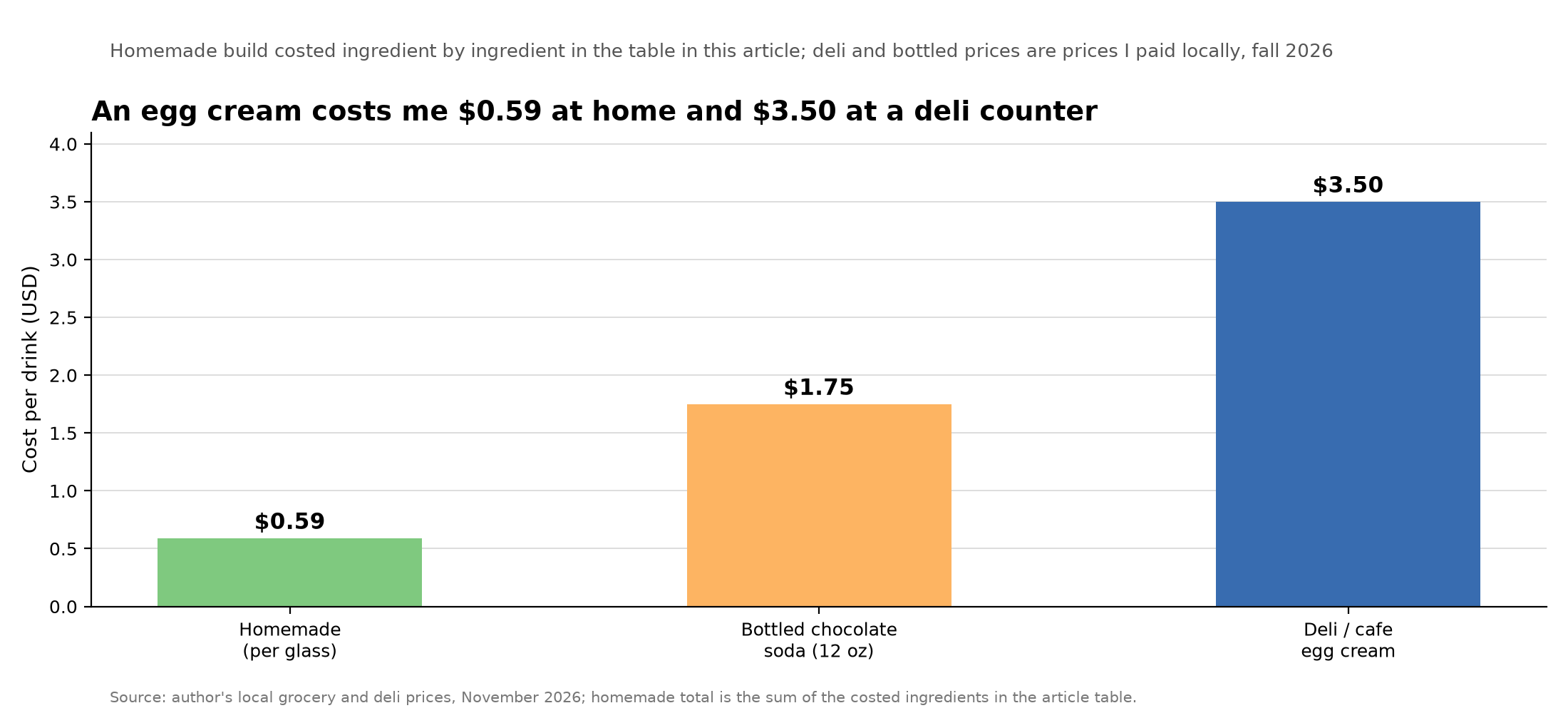
Homemade egg cream at $0.59 a glass on the costed recipe in this article, against a $1.75 bottled chocolate soda and a $3.50 deli egg cream. Prices are the author local prices, November 2026.
Myth 3: It keeps, and low-fat milk is fine
Neither survives testing. The head collapses within minutes because it is a foam of milk and gas with nothing stabilizing it, no egg, remember, and no ice cream. Make it, hand it over, drink it. As for the milk: whole milk foams because of its fat and protein balance; skim milk gives you a thin, soapy head that dies in the glass. I tested 2 percent as a compromise and got about half the head height. If dairy is the issue, oat milk is the least-bad substitute I have found, though the flavor moves toward the syrup. For a cold-weather counterpoint with the same three-ingredient discipline, our cranberry ginger soda holds up far better in a pitcher, because nothing in it depends on a 90-second foam.
One last piece of fountain etiquette that doubles as quality control: an egg cream should be drunk from the glass it was built in, through the foam, not stirred down and not straw-sipped from the bottom. The contrast, bitter-white foam first, sweet chocolate milk under it, is the drink Auster's customers lined up for. Get the pour right once and you will understand why a drink with neither of its named ingredients outlived the century that invented it.
Get the newsletter
New articles and the occasional deep dive. No spam.
Unsubscribe anytime. We never sell your email.